RADWINTER RECORDERS
ANNUAL REPORT 2008
Poles Apart
An article is being prepared on the Polish airmen who settled in Radwinter and Wimbish and grew mushrooms there at the end of the Second World War. Thanks to Freda Piechocki, Kath Browne, Janet Swan, Joy Matthews, Zofia Everett and researches at The Polish Institute and Sikorski Museum as well as the Internet, much is known about the career of Freda’s husband, Leon and of the other airmen.
Several people have been interviewed, military records of Polish servicemen have been obtained and exciting stories are emerging about escapes from occupied Europe, and acts of heroism by the Polish Armed forces.
There is a powerful story to be told about how the brave Poles were key in winning the war against Germany. If anybody knows anything about these men, including Mr Sancewicz who owned the Radwinter Mushroom farm, as well as Edmund Helwig, Jan Dziedzic, Mr. Kraszewicz, Mr. Paszkowski, Mr Zetzetch (all known to have been about these parts), I would be most grateful to hear from them, however minor the information is.
So I can find out when the various mushroom growers were living in Radwinter and Wimbish, I will need to track down the rate books of the old Saffron Walden District Council. Can anybody throw light on this? Electoral Registers are of no use because the people concerned were not British Citizens. We owe it to these brave Polish men and women to preserve their memory, as the skilled Polish Airmen were a major force in winning the Battle of Britain and the Polish Army brigades fought for the Allies with distinction in most of the important theatres of war. |
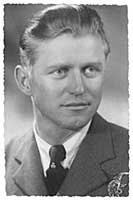
Leon Piechocki
|
Sapper Seabrook
Thanks to Mrs Elsie Bacon, more has emerged on Spr. George Seabrook the First World War soldier, whose war diaries were found in the Radwinter archives. George Seabrook and his wife were related to the wife of the publican at the Red Lion and stayed there after the end of the Second World War.
The Radwinter Friendly Society
One most interesting document that has emerged from recent accessions to the Radwinter Archives, is an early photocopy of the “Articles to be Observed by a FRIENDLY SOCIETY of Tradesmen and Labourers, who agree to meet every fourth Saturday at the PLOUGH PUBLIC HOUSE, in the Parish of Radwinter, in the County of Essex”.
The Articles were printed by E Hart, Bookseller, Market Street, in 1837 and state that the Society was inaugurated on 27th February 1836. Members dibbed into the pot at their fortnightly meetings and, if anybody was sick, they could draw relief from the Society. Some of the rules appear quite hilarious to present day eyes but demonstrate the harsh conditions and very different times in which our ancestors lived. Mention is made in the document to the Radwinter Smallpox house. Does anybody know where that might have been?
I had recently been called in by the Saffron Walden Museum as they had found some accounts of the Society of a later period. Hopefully the documents can be reprinted and the names of those involved indexed. Edward Halls and Daniel Richardson were stewards of the Society and John Chapman was its clerk. Other ancestors of present day Radwinter people were among the members.
From the Radwinter Registers
On 1st August 1835 Abraham Swan (batchelor) married Mary Coote (spinster). Five years later on 23rd October 1840 Isaac Swan (batchelor) married Elizabeth Greygoose (spinster).
On 7th October 1675 William Blewett married Susan Nettell at Radwinter Church, this being her ninth husband.
A Parson’s Lot
John Walter’s talk, A Parson’s Lot, in Radwinter Church on 21st April, was a roaring success and was given to a packed church. John Walter, who is Professor from the Department of History of Essex University, brought to life the assaults and insolences that drove Parson Richard Drake out of Radwinter. After a series of clashes with his parishioners such as Thomas Banes, Abraham Chapman and Henry Coote, not to mention the troublesome wives, Drake was forced to flee Radwinter in 1643.
Drake's autobiography offers valuable evidence of the successful attempt of loyalists in the revolution to continue to live their lives by the rites of the Anglican Church. After the Restoration of the Monarchy Drake came into his own. Restored to his living of Radwinter, he became a chaplain to Charles II. In September 1662, shortly after the death of his wife, he was collated prebendary of Alton Borealis in Salisbury Cathedral. He was chancellor from 1663 until his death. Drake resigned at Radwinter in 1667, and when he died on 16 October 1681 he was also rector of Wyke Regis, Dorset. He was buried in Salisbury Cathedral. The evening was a joint venture between the Friends of Radwinter Church and the Radwinter Society.
Where Did It All Go?
After the meeting John Walter asked if anybody knows what happened to various items in Radwinter Church which would have been replaced by Fred Bullock’s restoration. I recalled some information I had been given by a man who had once lived at a house in Mount Pleasant Road, Saffron Walden. It had been built in 1896 by a builder called Bell. It is semi-detached, one third being built for Bell’s own use and two thirds as a wedding gift for his daughter.
It is built in the style of a church, particularly the window stone and the front door. The outside of the building is of brick clad in stone. The words, “aged 17” can be seen engraved in the stone and the building appears to be entirely clad in broken grave stones. The story goes that Bell undertook the church restoration at Radwinter after which nobody could find the stained glass windows. The bottom half of all ground floor windows are of stained glass.
The story is also told of Bell making off with the Bell from Newhouse farm when he repaired the roof there. Perhaps it had an affinity with his name
A current resident has also told me that there used to be a small stone receptacle in the front garden of the Cottage attached to the Village Hall. She had had her eye on it for years but she doesn’t know when it disappeared. It may be that it went during the recent refurbishment. From her description it sounds as though it might have been a font. Does anybody know of its whereabouts or does anybody have a photograph of the front of the Village Hall which might show it?
Radwinter Ghosts
More information has emerged on the earliest Radwinter ghost story. The Revd. John Mountford, M.A. who was Rector of Radwinter from 1593 to 1603 and why he temporarily lost his living.
Mountford had enemies and was removed by the authorities from Radwinter. No reason was given but the Patron of the living, Lord Cobham, had been in trouble with the Government and was executed. Later, in 1606, the incumbent who succeeded Montford, Richard Cradock, clerk, stood trial in the Star Chamber. Richard Cradock had become priest at Radwinter in 1603 but, on 22nd June 1604, his institution was revoked and Mountfort was restored.
In the 1606 Star Chamber trial Richard Cradock, clerk and the many other Radwinter residents were accused by John Mountford, Vicar of Radwinter of conjuring up false spirits in the church and churchyard of Radwinter in an attempt to secure possession. Full details are given in the records of the Star Chamber under Mountford v. Cradock, Byrd, Martyn, Brett, Smith, Starling, Smith, Baker, Tailour, Sparcke, Smith and others. A copy of the plea by John Mountford has been obtained and is currently being transcribed.
I repeated my Radwinter Ghosts talk to the Hempstead History Society and to Radwinter W.I. and both times collected further stories and additions. Research has elucidated the discrepancy between the two versions of the New House Farm ghost showing that Mrs Freeman was a Miss Gocher before her marriage. Ghost stories, being one of the most potent forms of oral history in terms of survival, are proving to be rich sources of Local History. More work is being done on the other ghost stories to see what they reveal.
Peter Thomas has kindly added another story about the ghost at Purkiss’s and Daphne Reader has identified herself as the source of the Disappearing Car story. Anybody with further Radwinter ghost stories to tell can have them added to the collection and, hopefully a small booklet will be printed in due course.
Prints of Radwinter Scenes
Several people have asked if it might be possible to obtain prints of the water colour paintings of Radwinter scenes that were shown in the centre pages of the spring 2008 edition of Ambo. They were taken from the sketch book of an unknown artist and are dated 1861. There are four views in all, two of the Wover, the pond in the grounds of Radwinter Hall, one showing Radwinter Hall garden with the church in the distance and one of the Church from Princes Well. Copies are now on sale mounted and framed, as single views or all four pictures mounted in one frame, price £18 each framing.
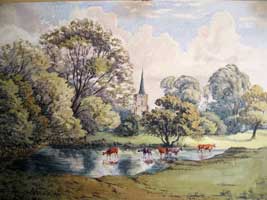
Painting of Wover |
.jpg)
Painting of Wover (Close-up)
|
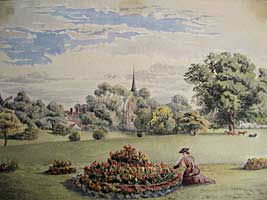
Radwinter Hall Garden |
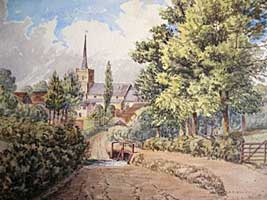
Church from Princes Well |
Uttlesford History Website
Uttlesford Local History Recorders launched their on-line database, RUTH, back in December of last year but since then teething troubles have beset the system and we have been unable to make it work in the way it should.
The decision was taken by Uttlesford Local History Records (now called Recorders of Uttlesford History) to build our own website and to include the RUTH database on that.
The website is now up and running at www.recordinguttlesfordhistory.org.uk/ where, in addition to giving access to RUTH, member local history recorders for the various Uttlesford Villages have posted information and photographs on their parishes.
By the end of 2008, some six hundred of the Radwinter records had been entered onto RUTH and the website allows you the facility of searching for any people, places and topics in which you may be interested and to bring up a list of all the records that meet your search requirements. You will then be able to read a short statement on what the particular record is all about. If you think you might want to see the record in question, contact me and I will arrange for you to see it or have a copy. The same applies to other villages, where you can search for the same type of information and then approach the local history recorder for that village to obtain further information.
Archival Quality Storage
Through grants I have obtained for Recorders of Uttlesford History from the Local History Initiative (Big Lottery) and from Uttlesford District Council, over a thousand Pounds worth of archival quality storage material is being purchased and will be shared out amongst member parishes. Radwinter’s share amounts to around £130 and will bring us boxes in which to keep the records, permanent non-fade marking pens, brass paper clips to prevent rusting clips and staples spoiling the documents, and polyester sleeves to keep the photographs safe. Our supply will by no means provide all our storage needs but will be a valuable start.
Now we need a convenient village centre location, where the archives can be stored and viewed. Grants are obtainable to turn a suitable room into an archive centre, with shelving and humidity control, all we need now is for some kind person to allow us to use a room for storage and public access.
Radwinter Christmas Cards
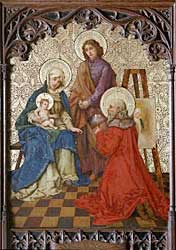
The Friends of Radwinter Church have produced a beautifully illustrated Christmas card in full colour at only £3.00 for pack of ten.
The card shows the apocryphal scene from the Radwinter reredos, or altarpiece, sometime called, Our Lady of Tenderness, which depicts the holy family, with Joseph and Mary and the baby Jesus in Mary’s lap. The scene is shown being painted by the Apostle Luke. The message inside the card is, Best Wishes for Christmas and the New Year. The cards are on sale in the Church, which is open for normal services and on the first Saturday morning of every month when coffee is also served. |
Virgin and St Luke |
Radwinter 1891 Terrier
A box containing a collection of terriers for local churches was recently handed into Ashdon Museum. The curator, Mr Glen Miller, presented the Radwinter Rectory Terrier for 1891 to the Radwinter Archives and gave the rest to the Essex Archive Access Point at Saffron Walden Museum. The Radwinter terrier came with three delightful photographs of ladies in Edwardian dress making hay on what looks like the Rectory Pasture (now Radwinter Manor).
The terrier says that, “The parsonage house (was) built by Revd. John Bullock in 1810 almost on site of older Parsonage in Rectory garden & surrounded by a moat; Stables built in 1812 and servants bedrooms and back kitchen added to Rectory in 1886; Churchyard with oak fence and details of addition to churchyard on 25 May 1882, additional ground consecrated on waste land on which stood the Parish Cage, partly of parish property (Almshouses pulled down) Public House, purchased by the Rector and given to the parish”. (The name of this public house is not given but is almost certainly The White Hart, formerly called The Faulcon and before that Nazes)
“Glebe Farm of which 50 acres held by Mr Charles Mizen and 10 acres of grassland by the Rector; Vicarage House occupied by Edward Gowlett, wheelwright. Field on Water Lane occupied by Mr Reuben Gowlett; Field adjoining Hill Farm held by occupier of Hill Farm.” Details given of plate and ornaments of the Church, include, “Two massive candlesticks copied from Southwell Cathedral. Benefactions connected with the Church include a Blacksmith’s shop & house. Also two acres of land which in the year 1854 was exchanged for the same quantity of land. There are no title deeds to either shop or land but the rents have from time immemorial been devoted by the Churchwardens to current church expenses. House or rent of the same from time immemorial devoted to the payment of the Parish Clerk”. The terrier was signed by John Frederick Watkinson Bullock, Rector and James Gowlett and Edwin Newell, Churchwardens.
Radwinter Brass Candlesticks
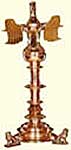
In the terrier of 1891 for the Incumbency of Radwinter there is mention of “Two massive standard candlesticks of brass copied from those in Southwell Cathedral. Upon enquiry, the Verger’s Vestry of Southwell Cathedral told me that the picture of the single candlestick I had sent them was, “Indeed the spitting image of a set we have in daily use in the quire”.
The Verger’s Vestry later e-mailed me to say that he had, “Just been on a trip to Ripon and, in the cathedral, in the chapel to the north of the sanctuary are a set of candlesticks just the same but look like they are of bronze”.
The Newstead eagle lectern, which stands in the centre of the quire at Southwell Minster Cathedral, was once owned by Newstead Abbey and was given to the Minster by Richard Kaye, Archdeacon of Nottingham (1780 to 1810). It is believed that the monks lowered the lectern into the Abbey fishpond wrapped in fabric or sacking to protect it during the Dissolution of the Monasteries. It was discovered when the fishpond was drained in the 18th century and is one of the few remaining pre-Reformation lecterns in the country. It is probable that the candlesticks at Southwell were made to match the Eagle lectern.
It looks as though the originals in Southwell Cathedral were admired at the time and perhaps were widely copied. It seems highly probable that William Eden Nesfield, the architect of Radwinter Church restoration, may have visited Southwell possibly because either he or Shaw was responsible for the restoration of a church nearby.
Nesfield was articled to his father's colleague, William Burn in whose practice he fell in with Richard Norman Shaw. For the first fifteen years of their friendship, their inspiration was gothic revival and they travelled abroad with each other on a sketching trip and later went into practice together.
It was said of Nesfield that “No English architect has ever sketched or drawn better”. At the beginning of his career, he broke his articles for two years and travelled a good deal with his Uncle Salvin and spent much time visiting and sketching the great cathedrals and churches of France, amassing the splendid topographical drawings which eventually went into Specimens of Mediaeval Architecture (1862), a copy of which was presented to the Friends of Radwinter Church by Dick Lloyd, shortly before his death. |
Newstead Lectern |
Ken Hall
We are sorry to announce that Ken Hall, the previous Essex County Archivist died on Thursday 12 June 2008. The funeral was on Friday, 20 June at St. Mary's Church, Little Sampford.
Ken Hall was the last holder of this post and will be remembered as the man who played a very prominent part in building the new Essex Record Office in Wharf Road, Chelmsford. His interests in retirement were varied and included his role as Church Warden at St. Mary's Church, Little Sampford and Hon. Secretary of the Sampfords Society, also Easton Lodge Gardens, all duties he fulfilled to the end.
Barker Family Bible
I have purchased and presented to the Radwinter Archives a family bible that was presented to Walter Barker and Minnie Elizabeth Chapman, by the Rector of Radwinter, John Frederick Watkinson (Fred) Bullock, on the occasion of their marriage on 1st June 1907. It is inscribed and signed by Fred Bullock.
Radwinter Sweet Shop
Among inclusions in the Barker family bible was a list of sweets and assortments together with their prices. As the bible had descended in the Barker family from Minnie Elizabeth Barker, née Chapman and her husband Walter Barker to Violet Elsie Turpin, née Barker and her husband George Frederick James Turpin and then to Brenda Kathleen Davidson, née Turpin and her husband Michael John Davidson, it is possible that one of these people worked in a sweetshop in Radwinter. If you have any information on the list, or these people, in connection with a sweetshop, do let me know.
Michael Southgate
Radwinter Village History Recorder